
How AI Agents Are Replacing the 20-Hour Content Week
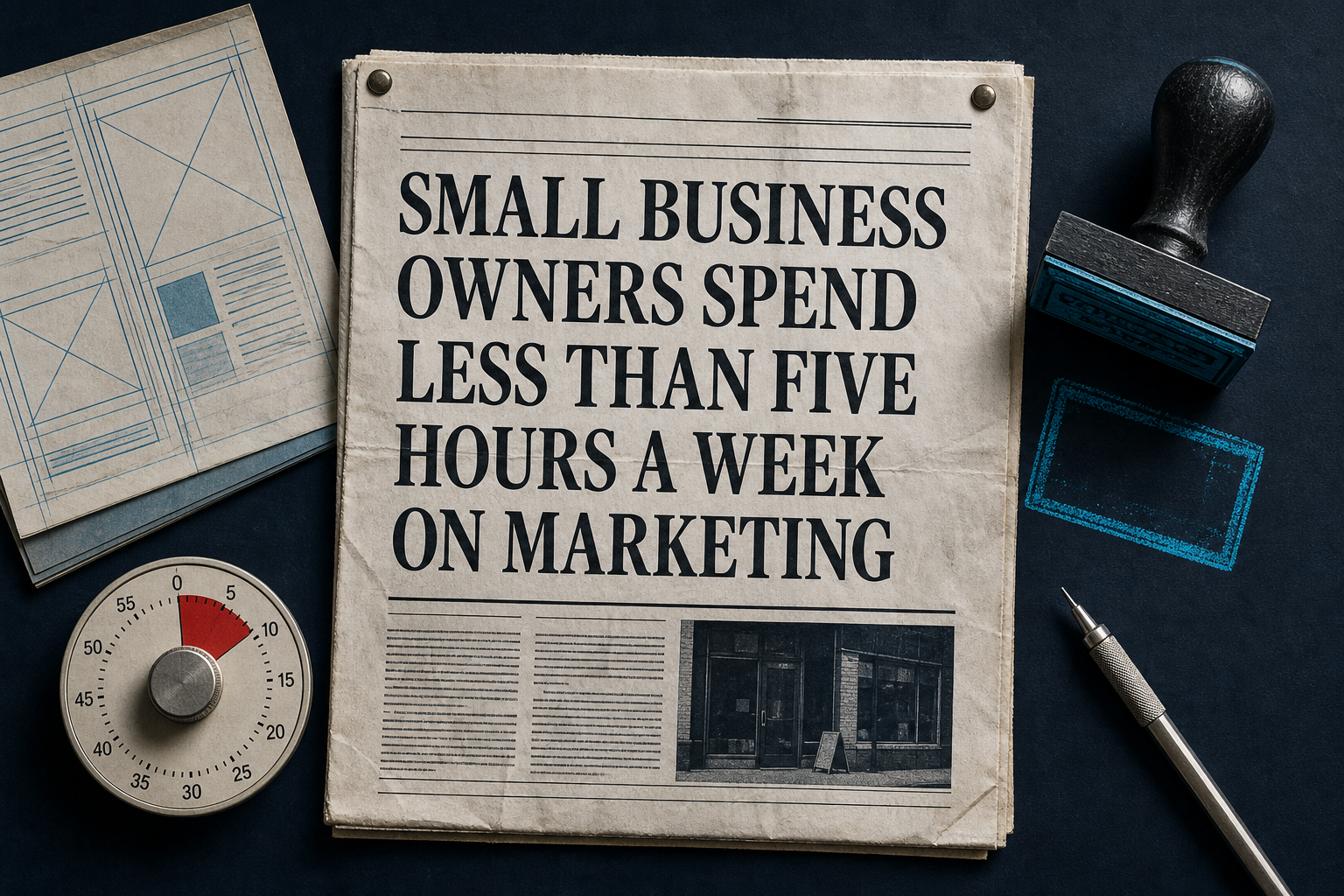
SEVENTY PERCENT OF SMALL BUSINESS OWNERS SPEND LESS THAN FIVE HOURS A WEEK ON MARKETING, NOT BECAUSE THEY DON'T CARE, BUT BECAUSE THEY DON'T HAVE THE TIME TO CARE.
By Steve Sanford
How AI Agents Are Replacing the 20-Hour Content Week
SEVENTY PERCENT OF SMALL BUSINESS OWNERS SPEND LESS THAN FIVE HOURS A WEEK ON MARKETING, NOT BECAUSE THEY DON'T CARE, BUT BECAUSE THEY DON'T HAVE THE TIME TO CARE. That's the real story behind AI agents and small business content. It's not that owners lack ambition. They're out of hours. A Fiverr survey found most owners see marketing as the top driver of growth, yet 70% give it under five hours a week, and the biggest reason is a lack of time, not a lack of budget or belief [1][2].
I've built and lost businesses over forty years, and I've never seen a gap this wide between what owners know they should do and what they actually have time to do. AI agents are closing that gap right now, and it's happening faster than most people running a business have noticed.
The 20-Hour Week Nobody Talks About
Content work for a solopreneur was never just writing. It's research, drafting, rewriting for six different platforms, checking the tone still sounds like you, scheduling, and then doing it all again next week. Add it up and you get somewhere close to a full workweek, every week, just to stay visible.
That's the trap. Content creation is now the single most common use of AI among small businesses, ahead of customer service, ahead of admin work, ahead of everything else [3]. Owners aren't experimenting with AI for fun. They're using it because the old way of producing content was quietly eating their week.
And the data on what that week actually costs is starting to show up. One study found small businesses using AI content tools saved close to $6,000 and grew revenue at the same time [4]. That's not a productivity trick. That's a business getting hours back and turning them into money.
What "AI Agent" Actually Means Here
Let's clear something up, because the term gets thrown around loosely. An AI agent isn't a chatbot you talk to once. It's a system that watches what needs to happen, reasons through the steps, and takes action inside boundaries you set. Think of it less like a tool and more like a very fast, very literal employee who never gets tired of doing the repetitive part of the job.
Here's where I get contrarian, and I'll back it with the numbers. Everyone's rushing to say AI agents are "autonomous." Fine, technically. But the businesses actually seeing results aren't the ones that let the agent run wild. They're the ones with guardrails. Human oversight doesn't mean human doing, it means human checking. That's the whole model. You set the direction, the agent does the grinding, you approve before it goes live.
This matters because the market is splitting into two camps fast. Gartner projects that task-specific AI agents will show up in 40% of enterprise applications by the end of 2026, up from under 5% just a year earlier [5]. That's not a trend, that's a floor falling out from under the old way of doing things. The businesses figuring out the guardrails now are building a structural advantage. The ones waiting to see how it shakes out are going to find there's no "shaking out" to wait for.
The Adoption Gap Is the Opportunity
Here's a stat that should make every solopreneur pay attention. More than half of executives say their organization has deployed AI agents. Less than a quarter have actually scaled one across the whole business. That gap tells you something important: getting access to AI isn't the hard part anymore. Getting it to work reliably, every time, in your voice, at your scale, that's the part almost nobody has solved.
This is exactly where fewer than 1% of people actually know what they're doing. Most treat an AI tool like a search box. Type in "write me a blog post," get something generic back, spend more time fixing it than you would have spent writing it yourself. That's not automation. That's a slower version of doing it yourself with extra steps.

The businesses seeing real efficiency gains, in the 40% range with meaningful cost reduction in year one, aren't the ones prompting randomly. They're the ones who built a system: a clear goal, a defined voice, a checkpoint before anything goes public. That's the difference between a task and a system, and it's the whole game.
Before and After: What the Week Actually Looks Like
Let me walk you through what changes when a solopreneur moves from doing content manually to running it through a properly built agent.
Before, the manual week:
- Monday: research topics, check what competitors posted, figure out an angle
- Tuesday: draft the core piece, rewrite it twice because it doesn't sound right
- Wednesday: chop it into social posts, try to keep the voice consistent across platforms
- Thursday: fix the pieces that don't sound like you anymore, schedule everything
- Friday: realize the email version needs a different tone, redo that too
After, the agent-driven week:
- You give the agent the goal, not just a topic, the actual business outcome you want
- It researches, drafts, and adapts the piece across every channel using a voice profile trained on how you actually talk and write
- You review it once, at a checkpoint, and either approve or send it back with notes
- It's live across six channels in the time it used to take to write one first draft
That's not a hypothetical. Businesses using AI agents for repetitive workflows are seeing efficiency gains around 40% and cost reductions near 30% in the first year, often within just a few weeks of implementation. The compression isn't the exciting part. The consistency is. Content creation is now the leading AI use case among small businesses specifically because it's repetitive, high-volume, bottleneck work, exactly the kind of task an agent is built to absorb [3].
Why Voice Is the Real Bottleneck, Not Volume
Everybody assumes the hard part of content is producing enough of it. It's not. The hard part is producing content that still sounds like one person, one brand, across five or six different channels, week after week. Post enough generic AI content and your audience notices before you do. They can't always say why something feels off. They just stop trusting it.
This is where most AI writing tools fall apart. They generate fine sentences. They don't generate you. And when marketing professionals are using AI tools daily at rates above 90%, with the vast majority using them specifically for content, the businesses that stand out won't be the ones using AI. Almost everyone will be doing that. The ones that stand out will be the ones whose AI-assisted content still sounds unmistakably like a real person who knows what they're talking about [6].
That's the misconception I want to name directly, because it stops a lot of small business owners before they even start. They think AI content means sacrificing their voice for speed. It doesn't have to. A properly built system learns your patterns, your phrasing, the way you'd actually explain something to a customer standing in front of you. Speed and voice aren't a tradeoff. They're both outputs of the same well-built system.
The Barrier That Isn't Real
I hear the same objection from small business owners constantly: "This sounds like enterprise stuff. I'm one person. I don't have a team to manage an AI agent." I get why it feels that way. Most of what gets written about agentic AI is aimed at companies with IT departments and six-figure software budgets.
But look at the actual adoption numbers. Content creation as the top AI use case isn't happening at Fortune 500 companies, it's happening at the small business level, where 41% of adopters are using AI specifically for content [3]. This isn't an enterprise trend trickling down. It started at the solopreneur level because that's exactly where the 20-hour content week hurts most.
You don't need a team to run an AI agent. You need one clear goal, one voice profile, and one checkpoint before anything publishes. That's ninety percent preparation, ten percent execution. Most of the work is upfront, deciding what "sounding like you" actually means in concrete terms. Once that's built, the weekly grind shrinks to almost nothing.
Building This the Right Way
If you're thinking about moving your content work to an agent-based system, here's how I'd approach it based on what's actually working right now:
- Start with one workflow, not five. Automate content fully before touching customer service or admin work.
- Track your actual hours first. You can't measure what you saved if you never measured what it cost.
- Build the voice profile before you build anything else. This is the part that takes real time and real thought, and it's the part that determines whether the output sounds like you or like everyone else using the same tool.
- Keep a human checkpoint. Every single time. Not because the agent can't produce good drafts, but because the businesses seeing durable results are the ones who never let it run without a review step.
This isn't a race to remove humans from the process. It's a race to remove the repetitive, soul-draining parts of the process so the human part, the judgment, the final approval, the strategic call, gets your full attention instead of your leftover energy.
Frequently Asked Questions
Do AI agents actually replace a full week of content work?
Not by working alone. The compression happens because the agent absorbs the repetitive parts, research, drafting, cross-channel adaptation, while you keep the review and approval step. Businesses using this approach are seeing efficiency gains near 40% in year one, with results often showing up within a few weeks.
Is this only useful for businesses with a marketing team?
No. Content creation is the top AI use case specifically among small businesses and solopreneurs, not large enterprises with dedicated staff [3][7]. If anything, the time savings matter more when you're the only person doing the work.
Will AI-generated content sound generic?
It will if the system isn't trained on your actual voice. Generic output is a sign of a poorly built system, not an inevitable outcome. The businesses getting real value are the ones that invest time upfront in defining voice and tone before scaling output.
What's the risk of letting AI handle content without oversight?
Consistency and trust. Human oversight doesn't mean human doing, it means someone still checks before anything goes live. The gap between businesses that deploy AI agents and those that successfully scale them comes down to exactly this kind of discipline.
Where This Goes From Here
I've spent forty years building companies, and I'm rebuilding one on AI right now, in public, mistakes and all. The 20-hour content week isn't some far-off problem to solve someday. It's happening to solopreneurs right now, and the tools to fix it already exist. The only question is whether you build the system with guardrails or keep grinding through it manually because building the system feels like one more thing on an already full plate.
I get it. I've been there more times than I can count. But if you're curious what this actually looks like from the inside, the wins and the messy parts both, come follow along. We're figuring this out together, one honest step at a time.
Sources
- Fiverr Small Business Month Survey: Marketing Seen as Key Growth Driver, Yet 70% of Owners Spend Less Than Five Hours a Week on It - Fiverr International Ltd. (investors.fiverr.com)
- Fiverr Small Business Month Survey: Marketing Seen as Key Growth Driver, Yet 70% of Owners Spend Less Than Five Hours a Week on It (fiverr.com)
- From Wait-and-See to All-In: How SMBs Are Rewriting Their AI ... (idc.com)
- Adobe study: SMBs using AI content tools save $6K and gain revenue (ppc.land)
- AI Agents Statistics 2026: Market Data, Adoption and ROI (sqmagazine.co.uk)
- 90% of Teams Use AI Agents: Marketing Adoption Data 2026 (thestacc.com)
- Small Business AI Adoption: 52 Stats (2026) | theStacc (thestacc.com)
Researched from 14 vetted sources · average source authority DR 77